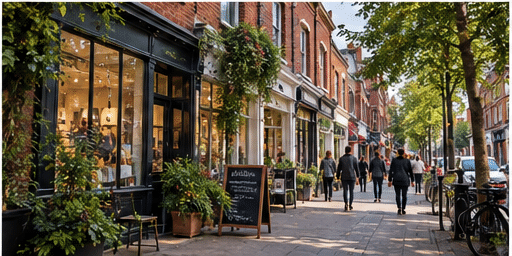

There is a version of Birmingham that exists between the landmarks.
It lives in coffee shops, independent restaurants, vintage stores, small galleries, neighbourhood pubs and businesses whose owners are often standing behind the counter.
Finding it requires one thing.
Slow down.
Birmingham is made up of districts with noticeably different personalities. Visit Birmingham highlights Digbeth and Southside for creativity, Brindleyplace for canalside dining, the Jewellery Quarter for heritage, Chinatown for food and the centre for major shopping.
But the fun begins when you stop treating those areas simply as destinations.
Take the Jewellery Quarter.
You could arrive with one shop or restaurant in mind, but the better approach is to give yourself a couple of hours and walk. Historic buildings, workshops, cafés and independent businesses make it an area where the spaces between your planned stops are often the most interesting part.
Moseley offers a different rhythm.
Leafy streets, cafés, pubs and a strong neighbourhood identity make it ideal for a slower weekend.
Digbeth is another proposition entirely: creative, colourful and proudly unconventional.
The independent city matters because it gives Birmingham personality.
Major brands have their place — and Birmingham is exceptionally well served for shopping — but you can find versions of the same international retailers in dozens of cities.
You can’t reproduce a genuinely local business quite so easily.
So create an independent Birmingham day.
Start with coffee somewhere you’ve never visited.
Browse without intending to buy anything.
Have lunch at a restaurant that isn’t part of a national chain. Find a pub with character. Walk instead of immediately ordering a taxi between stops.
Most of all, talk to people.
Ask what’s good on the menu. Ask the shop owner what has just arrived. Ask where they’d recommend going next.
That’s how one discovery becomes three.
Supporting independents is often presented as a worthy responsibility, but that misses the more enjoyable point.
Independent businesses frequently make cities better places to live.
They take risks, occupy unusual spaces, introduce new ideas and give neighbourhoods identities that can’t be designed by committee.
Birmingham has plenty of them.
The only requirement is that occasionally we remember to look.

